
Engineered Shoring Plans in Florida for Elevated Concrete Slabs
Shoring plans in Florida are the PE-sealed construction documents that specify every detail of the temporary support system for elevated concrete slabs, shore type, spacing, bracing, load capacity, and removal sequence. Without approved shoring plans, no building department in Florida will authorize an elevated concrete pour.
- Licensed professional engineer in Florida
- Signed and sealed reports
What Are Shoring Plans in Florida?
Shoring plans in Florida are the PE-sealed construction documents that specify every detail of the temporary support system for elevated concrete slabs, shore type, spacing, bracing, load capacity, and removal sequence. Without approved shoring plans, no building department in Florida will authorize an elevated concrete pour.
The Florida Building Code requires shoring plans in Florida to carry the seal of a licensed Professional Engineer, and ACI 347 sets the national standard for shoring and formwork design that Florida adopts.
Paul Pineda, PE has produced shoring plans for over 50 projects across South Florida, from the SLS Lux Brickell high-rise in Miami to the Chanel Store renovation in Palm Beach. His shoring plans include not just the shore layout, but also reshoring schedules, concrete strength requirements, and coordination details that contractors need to execute the work safely and pass inspection.
This guide covers what a complete set of shoring plans includes, how the Florida permit process works, and what to expect in terms of cost and timeline. Whether you are a general contractor preparing a permit application or a developer budgeting for structural engineering, the details will help you understand exactly what you are paying for.
Step 1: What a Complete Set of Shoring Plans Includes
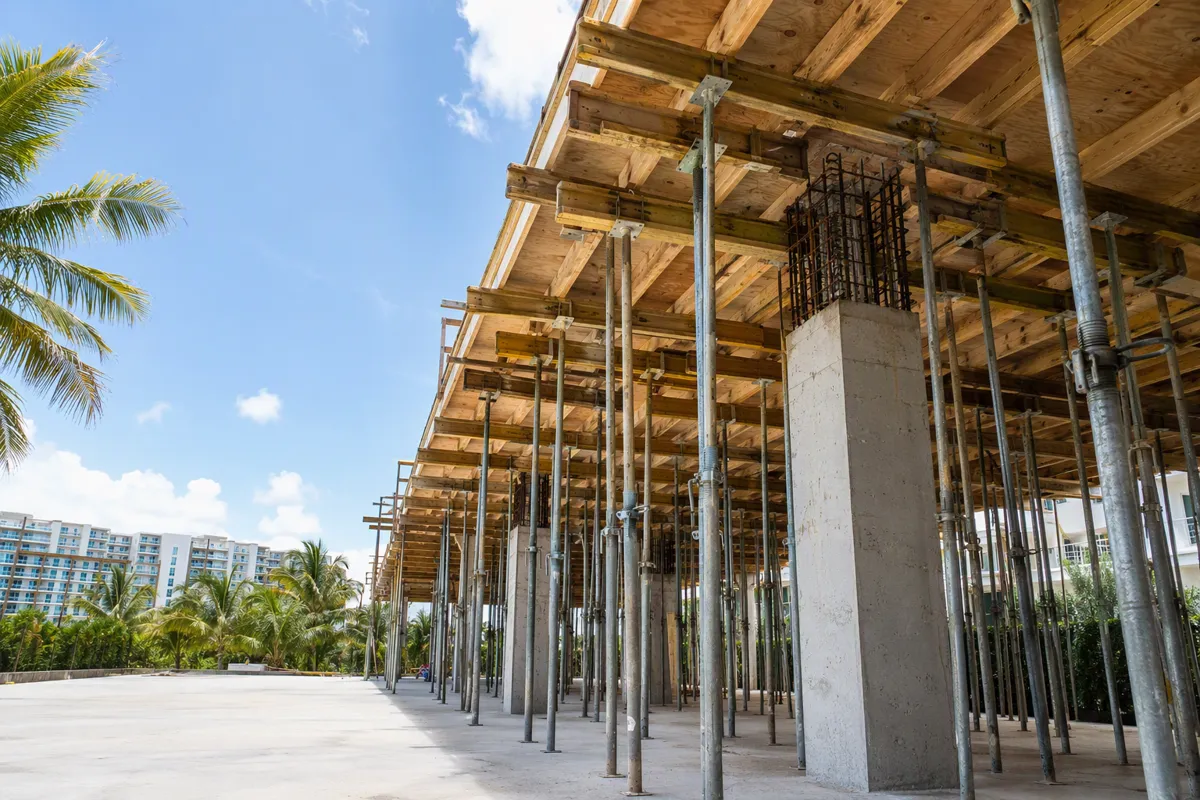
A professional set of shoring plans in Florida contains several key components. The plan view shows the grid layout of shores across each floor, with exact spacing dimensions. Elevation views show shore heights, bracing, and connections to the formwork above and the bearing surface below. A load table lists the required capacity at each shore location, derived from the weight of wet concrete, construction live loads (50 psf minimum per ACI 347), equipment loads, and wind loads.
The calculation report, attached to or referenced by the plans, documents the engineering analysis behind every dimension. This includes individual shore capacity checks, cumulative load analysis for reshored floors, base plate bearing calculations, and lateral bracing requirements. Florida building departments review these calculations during the permit process, and any gaps or errors trigger a revision cycle that delays your project.
Reshoring details are a mandatory part of any multi-story shoring plan. When a new slab is poured on an upper floor, the wet concrete load transfers through the shores to the floors below. If those lower slabs have not reached adequate strength, they can crack or fail. Paul Pineda’s shoring plans always include a reshoring schedule that specifies minimum concrete cylinder break strengths before shore removal and the sequence for shifting shores between floors.
For the Aventura Parksquare project, Paul produced 14 separate pour-zone plans with coordinated reshoring schedules for Areda Construction. The plans specified both PERI Systems and Aluma Systems equipment to handle varying floor heights across the mixed-use complex, a level of detail that prevented field conflicts and kept the project on schedule.
Step 2: Florida Permit Requirements for Shoring Plans
Every jurisdiction in Florida requires PE-sealed shoring plans before issuing a permit for elevated concrete pours. The specific submission requirements vary by county. Miami-Dade County requires a separate shoring permit application with plans, calculations, and a DBPR-verifiable PE license. Broward County has similar requirements but uses a different review process. Palm Beach County municipalities each have their own submission checklists.
For threshold buildings, structures exceeding certain height or area limits under Florida Statute 553.71, the plans must also identify the Threshold Inspector who will observe the shoring installation and concrete pours. Paul Pineda holds a Threshold Inspector license, which means his shoring plans and the required threshold inspection come from the same firm. This eliminates the coordination delays that occur when the plan designer and the field inspector work for different companies.
The typical permit review timeline for shoring plans in Florida is 2-4 weeks in Miami-Dade and Broward counties. Plans that are complete and code-compliant on first submission can be approved in as little as 10 business days. Plans with deficiencies go through one or more revision cycles, adding 1-2 weeks each. Studio A Engineering maintains a first-submission approval rate above 90% because Paul reviews every set of plans against the specific AHJ’s checklist before submission.
Step 3: Material Specifications and Load Calculations in Shoring Plans
Shoring plans in Florida must specify the exact equipment to be used, not just generic “shores.” The plans identify the manufacturer, model, and rated capacity of each shore type. Common systems include aluminum post shores (rated 5,000-12,000 lbs depending on extension), steel frames, and engineered tower systems from suppliers like Alsina, PERI, and Aluma. The engineer verifies that the rated capacity of each shore exceeds the calculated demand with an appropriate factor of safety, typically 2:1 per OSHA 1926 Subpart Q requirements.
Load calculations in the plans account for four primary load categories: dead load from wet concrete and formwork, live load from workers and equipment, environmental loads from wind in Florida’s coastal zones, and impact loads from concrete placement. For post-tensioned slabs, the plans must also address the load redistribution that occurs during the stressing sequence.
At the Grand Beach Hotel in Bay Harbor Islands, the shoring plans specified Alsina Formwork systems to support 10-inch post-tensioned slabs with large openings for mechanical chases. The load calculations had to account for concentrated loads at the edges of these openings, where the shore spacing was tighter than the typical grid. These details, specific to the actual site conditions, are what separate professional shoring plans from generic templates.
Why Professional Shoring Plans Florida Contractors Trust Are Essential
The difference between professional shoring plans and contractor-produced sketches is liability protection. When a PE seals a set of shoring plans, that engineer accepts legal responsibility for the adequacy of the design. If a failure occurs and the shoring was installed per the sealed plans, the contractor has documentation proving they followed a licensed engineer’s design. Without sealed plans, the contractor bears full liability for any shoring-related incident.
Florida’s construction accident statistics underscore why this matters. OSHA reports that structural collapses during concrete placement, often caused by shoring failures, result in an average of 8-12 fatalities per year nationally, with Florida consistently ranking high for construction-related incidents due to its volume of concrete construction. Proper shoring plans, designed by a licensed PE and verified by a Threshold Inspector, are the primary defense against these failures.
Paul Pineda brings over 20 years of structural engineering experience to every set of shoring plans. A graduate of the National University of Engineering in Lima, Peru, Paul understands both the engineering theory and the field reality of elevated slab construction. His shoring engineer Florida page details his approach to every project, and his common mistakes article identifies the errors he sees most frequently in plans produced by less experienced engineers.
Studio A Engineering, based in Doral, FL, serves projects from Key West to Jacksonville. Paul coordinates directly with formwork suppliers and scaffolding contractors to ensure the plans match the equipment that will actually arrive on site, a step that many engineering firms skip, leading to costly field modifications.
How Much Do Shoring Plans in Florida Cost?
The cost of professional shoring plans in Florida depends on project size and complexity.
Standard Mid-Rise Building
For a standard mid-rise building (5-15 stories), expect to pay $5,000-$20,000 for a complete PE-sealed plan set with calculations.
High-Rise Projects
High-rise projects (20+ stories) with multiple pour zones and complex reshoring requirements typically range from $15,000-$40,000. These fees include the sealed drawings, calculation report, and coordination through permit approval.
Fixed-Fee Proposals
Studio A Engineering provides fixed-fee proposals for every shoring plan project. There are no hourly surprises. The proposal clearly states what is included (drawings, calcs, permit coordination, one round of revisions) and what costs extra (additional revisions, threshold inspection visits, rush delivery).
Factors That Affect Shoring Plan Pricing
Several factors affect pricing for shoring plans in Florida:
- The number of elevated slabs
- Slab thickness and span length
- Whether the structure uses post-tensioning
- The number of distinct pour zones
- Threshold building classification (which adds inspection costs)
- The AHJ’s review requirements
- Rush turnaround, needed when a project is already under construction and the permit is holding up the next pour, adds a premium of 25-50%.